Key takeaways
- Companies outsource customer service to cut costs, scale with demand, and cover 24/7.
- Outsourcing turns fixed in-house costs into flexible, pay-for-active-hours spending.
- It also adds trained agents, omnichannel tech, and faster staffing than hiring in-house.
- Main risks are inconsistent brand voice, quality, compliance gaps, and less direct control.
- Most drawbacks stem from rigid, seat-based BPO models, not outsourcing itself.
- ShyftOff offers 3x same-day flex, 17,000+ credentialed agents, and 35-55% cost savings.
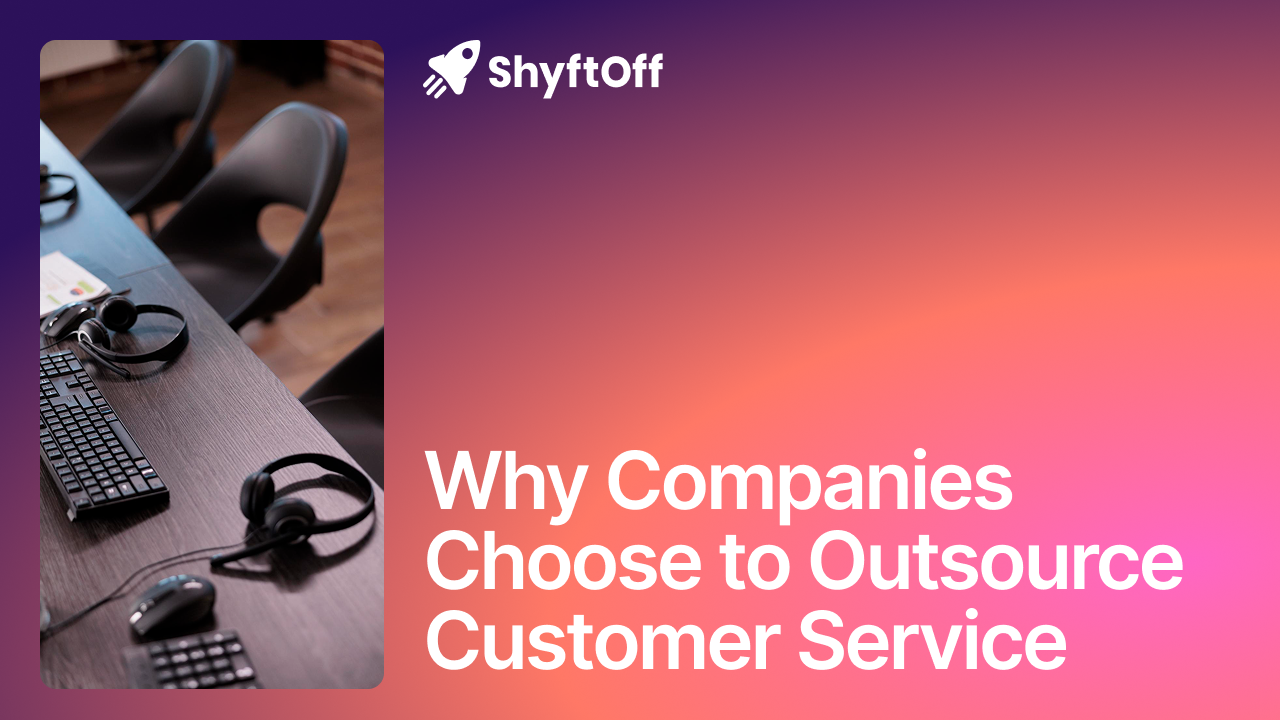
Companies outsource customer service to control costs, scale coverage with demand, and provide 24/7 support. The benefits of outsourcing customer service also include access to trained agents and specialized technology, without having to build everything in-house.
The scope of outsourcing varies by company. It can cover one channel, selected support tiers, overflow periods, or the entire operation. The right model can accelerate staffing and free internal teams to focus on product and growth, though results depend on provider quality, pricing structure, compliance, and brand alignment.
What Outsourcing Customer Service Actually Means
Outsourcing customer service means entrusting a third-party provider with a portion of your support, or leaving phone, chat, email, or social media support entirely to them. The vendor provides the necessary operational infrastructure, including trained support professionals, scale management, and tools.
Grand View Research valued the global call and contact center outsourcing market at $102.9 billion in 2025 and projected it to reach $110 billion in 2026.
The scope of service models is also rapidly expanding, allowing companies to choose a tailored solution based on their needs. Offshore models often offer lower labor costs, while onshore customer support outsourcing can offer greater familiarity with local markets and traditions.
Nearshore models can balance cost savings with geographic, linguistic, and cultural proximity. For instance, US companies can use Mexican or Costa Rican agents familiar with American culture and CX customs at a more reasonable price than hiring onshore support.
The model is also important, as traditional BPOs rely on full-time agent blocks, while a scalable, gig-based solution rotates the agent lineup based on volume requirements.
The Main Reasons Companies Outsource Customer Service
Why outsource customer service? We’ve already mentioned that the main reasons to outsource customer service include cost savings and 24/7 coverage, but that’s just scratching the surface. Here’s why companies outsource customer service at a glance:
Cost Efficiency and Turning Fixed Costs Into Variable Ones
Most companies decide to outsource customer support to reduce costs. Cost savings vary considerably according to geography, volume, service complexity, coverage requirements, and pricing model, but Deloitte’s 2024 Global Outsourcing Survey found that 80% of executives planned to maintain or increase investment in third-party outsourcing.
Outsourcing can replace several fixed in-house costs, including recruitment, salaries, benefits, training, equipment, and management, with a contracted operating expense. However, the cheapest quoted rate is not always the lowest total cost.
For instance, seat-based contracts require you to pay a fixed hourly rate, whether the outsourced call center agent is idle or interacting with a customer. On-demand staffing models offer a more flexible alternative, as you pay only for active hours.
Scalability and Flexibility for Seasonal and Surge Demand
Regardless of the industry, many businesses experience sudden spikes in support demand during important holidays, outages, and product launch events. That’s where the limitations of a fixed in-house team become clear: hiring agents fast enough in those periods of demand can be a challenge.
The ramp-up time is slow, and periods of lower demand would probably mean you also have to let some agents go. That leads to one of the biggest benefits of customer service outsourcing: flexible staffing. Traditional BPOs often have slower staffing due to rigid contracts, so an Agentic Workforce Delivery Platform with flexible models and fast onboarding can offer a faster alternative.
24/7 and Around-the-Clock Coverage
According to Zendesk’s 2026 customer experience report, 74% of customers now expect customer service to be available 24/7, while 88% expect faster responses than a year ago. Relying on just an internal team to cover multiple time zones and work weekends and holidays is simply a stretch.
In this case, a distributed provider can often extend coverage at a lower cost.
Speed to Staff and Faster Onboarding
Those wondering when to outsource customer service often find the answer during unexpected volume surges that follow rapid business growth. Outsourcing customer support enables volume management at scale, so the service keeps up with your customers' needs.
Outsourcing can shorten the ramp compared with recruiting and training an in-house team from scratch, although timing depends on the complexity of the work. ShyftOff can certify agents on client materials in about two weeks, while traditional BPO implementations may take considerably longer.
Focus on the Core Business
Outsourcing models also make sense for companies looking to keep internal teams focused on product, growth, and strategy. It relieves internal teams of recruitment, agent training, scheduling, and quality control.
Access to Expertise, Technology, and Better Customer Experience (CX)
Outsourcing can also provide access to experienced agents, established operating practices, omnichannel technology, workforce management, and quality-assurance systems without requiring the company to build each capability internally.
In 2026, the CX infrastructure has grown and improved, especially with models that combine AI insights with human input. AI-powered solutions for optimizing live chat support and advanced AI ticketing systems enable companies to streamline their support operations and access the latest technology without building it in-house.
These customer service outsourcing benefits are strongest when the provider combines capable agents with transparent quality controls and technology that integrates with the company’s existing support stack.
The Trade-Offs: Is Outsourcing Customer Service a Good Idea?
Making the final decision requires you to look at both the pros and cons of outsourcing customer service. We’ve already gone through the main benefits, so let’s focus on potential risks. One common risk is inconsistent brand voice.
If outsourced agents lack product knowledge or aren’t familiar with your customers’ CX expectations, poor interactions may result in lower customer satisfaction scores. That’s why it’s important to find specialized outsourced agents with hands-on experience in handling requests in your niche.
Other potential drawbacks include inconsistent service quality, communication or time-zone friction, slower feedback loops, and less direct day-to-day control. Clear escalation paths, transparent reporting, strong quality monitoring, and well-defined service-level agreements can reduce these risks.
Tightly regulated industries like healthcare and finance can outsource customer service, but they require stricter vendor due diligence. Providers must be able to demonstrate appropriate security controls, compliance processes, auditability, and agent training. The real risk here is selecting a provider that cannot meet the organization’s regulatory and data-handling requirements.
So, is outsourcing customer service a good idea in this case?
It can be a great idea if you pick the right provider with a clear pricing model, the required coverage, and relevant industry expertise. The choice of a model is just as important.
When Should You Outsource Customer Service?
Here are some common scenarios where outsourcing customer service makes most sense:
- Your support volume is volatile and affected by seasonal spikes.
- Your fixed support labor and overhead costs are becoming difficult to sustain.
- Volume shifts require a faster option than in-house agent onboarding can provide.
- Handling support queries detracts from your team’s ability to focus on core business.
- Your customer base requires 24/7 coverage across multiple time zones.
- Customer satisfaction, response times, or service consistency are beginning to decline.
If a few of these sound familiar, outsourcing is worth a serious look. Talk to an expert, and we will help you figure out whether it fits your situation.
Getting the Benefits Without the Legacy Trade-Offs: the Modern Model
Many familiar outsourcing drawbacks stem from rigid, seat-based BPO arrangements that reserve full-time capacity even when demand changes. Newer models use flexible pools of brand-certified agents and software-driven orchestration to align staffing more closely with actual support volume.
ShyftOff’s Agentic Workforce Delivery Platform is one such alternative. The platform can provide 3x same-day flex, manage access to more than 17,000 credentialed agents, and reduce operating costs by 35% to 55% compared with traditional models. It also uses AI-powered agent matching and quality assurance while certified human agents handle complex customer interactions.
This means clients pay for productive time, rather than breaks, lunches, training, or upskilling. You can see how it works to trace the model from staffing through quality assurance.
Frequently Asked Questions
Why do companies outsource customer service?
Companies mainly outsource customer service to reduce costs and scale support efforts based on demand. Delegating support to specialized third-party providers helps achieve 24/7 coverage and greater flexibility during peak volume.
Is outsourcing customer service a good idea?
Yes, outsourcing customer service can be a good idea for scaling startups and companies looking to expand their global reach and audience. It combines flexible models with 24/7 availability and multilingual support.
Is it cheaper to outsource customer service?
Outsourcing can be cheaper, but it is not automatically the lower-cost option. Maximum savings can be achieved by using systems with flexible models, but the result depends on volume, geography, service complexity, required coverage, transition costs, and whether the contract charges for reserved capacity or productive time.
What are the disadvantages of outsourcing customer service?
Common disadvantages of outsourcing customer service include weaker brand knowledge, inconsistent quality, data-security or compliance risks, communication friction, and less direct control. Strong onboarding, clear service-level agreements, transparent reporting, and robust quality assurance can reduce these risks.
When should a company outsource customer service?
A company should consider outsourcing customer service when support demand is volatile, hiring cannot keep pace, 24/7 coverage is required, service quality is slipping, or support operations are distracting internal teams from core work.

Explore more of our Blogs









%2520(1)%2520(1).avif)


.avif)

.avif)


.avif)

.avif)


.avif)


%2520(2).avif)

.avif)
More of our Resources
Our Blogs
The solution has been deployed across more than 125 tourism organizations

Our Webinars
The solution has been deployed across more than 125 tourism organizations
Our Guides
The solution has been deployed across more than 125 tourism organizations
Our Stories
The solution has been deployed across more than 125 tourism organizations
Our Podcasts
The solution has been deployed across more than 125 tourism organizations
Our Events
The solution has been deployed across more than 125 tourism organizations