Key takeaways
- Call center outsourcing focuses only on voice calls, while contact center outsourcing supports multiple channels.
- Traditional call centers and BPOs lack flexibility for unpredictable, multichannel customer demand.
- BPOs offer full-service management but struggle with on-demand scaling during volatility.
- GigCX enables flexible, on-demand staffing that matches support capacity to real customer demand.
- Modern contact centers blend GigCX, in-house teams, and AI for scalable customer experiences.
Contrary to popular belief, call center outsourcing and contact center outsourcing are different. Even though professionals use the terms contact center and call center interchangeably. Today’s customers have more options than ever to contact a company for support. When it comes to outsourcing, it’s essential to understand the difference between the two to identify the right solution for your business.
An outsourced call center is typically responsible for answering inbound calls from customers. They may even conduct outbound calls to survey, sell products, or collect information from existing customers or prospects.
An outsourced contact center isn’t limited to just calls. Contact centers are responsible for serving customers across multiple channels, which include social media, email, live chat, forums, and phone calls.
Why does the difference matter when outsourcing?
The most common ways companies outsource customer service operations are offshore call centers and business processing outsourcing services (BPOs). Offshore call centers specifically handle inbound or outbound calls. Offshore call centers are also great at doing specific tasks related to servicing calls–think of an appointment setter. Leaving the companies who contract them to manage resource planning and operations while the offshore call center handles answering calls.
BPOs, on the other hand, are capable of managing the whole call center or contact center operation. BPOs also leverage offshore call centers with the added services of workforce planning, resource management, and agent training. For companies that want a done-for-you solution, BPO is typically the way to go.
Outsourced call centers and BPOs have been around for decades and, as a result, are experts at operating call centers. Most aren’t exactly designed to manage complex contact centers with multiple customer support channels and hard to predict customer needs.
Modern contact centers often find that they can’t rely solely on a BPO or outsourced call center alone. Today’s contact centers use these outsourcing options AND require an in-house team paired with other customer support solutions, like AI chat or GigCX, to create a stellar customer experience.
Call Center vs. Contact Center Outsourcing
Call center outsourcing is often the least expensive outsourcing option. Outsourced call centers almost always leverage offshore talent to help keep costs low for businesses.
This type of outsourcing makes sense if calls are the only way you provide customer support. However, if you’re thinking about expanding to other channels, you might find yourself seeking another outsourcer to support your business. Call centers are exclusively designed only to support calls.
If you choose to leverage an outsourced call center, you may need to enlist an expert in-house team to handle complex customer issues, quality assurance, and training.
As mentioned above, companies that have multiple customer support channels will need an outsourcing solution that does more than handle calls. This is where BPOs come in. BPOs can outsource multiple roles, everything from management to analysts.
They also have experience executing the done-for-you model to help companies lower the cost of operating their own contact center in-house.
Where BPOs fall short is they don’t have the model to flex outsourcing capacity on demand. If your business has volatile seasonality or your customer needs are hard to predict, you may run into more challenges than solutions relying on a BPO.
Modern outsourcing for contact centers
As cited in our Ultimate Guide to GigCX, GigCX is a term that refers to a customer service model that leverages a pool of on-demand, independent contractors or freelancers to provide customer support services. The word "GigCX" is derived from the gig economy. Usually, companies such as Uber, Lyft, and Airbnb that rely on independent contractors come to mind for most people.
Unlike traditional outsourced call centers and BPOs, GigCX can help companies scale their customer service needs to match customer demand perfectly.
The graphic below best demonstrates this concept.
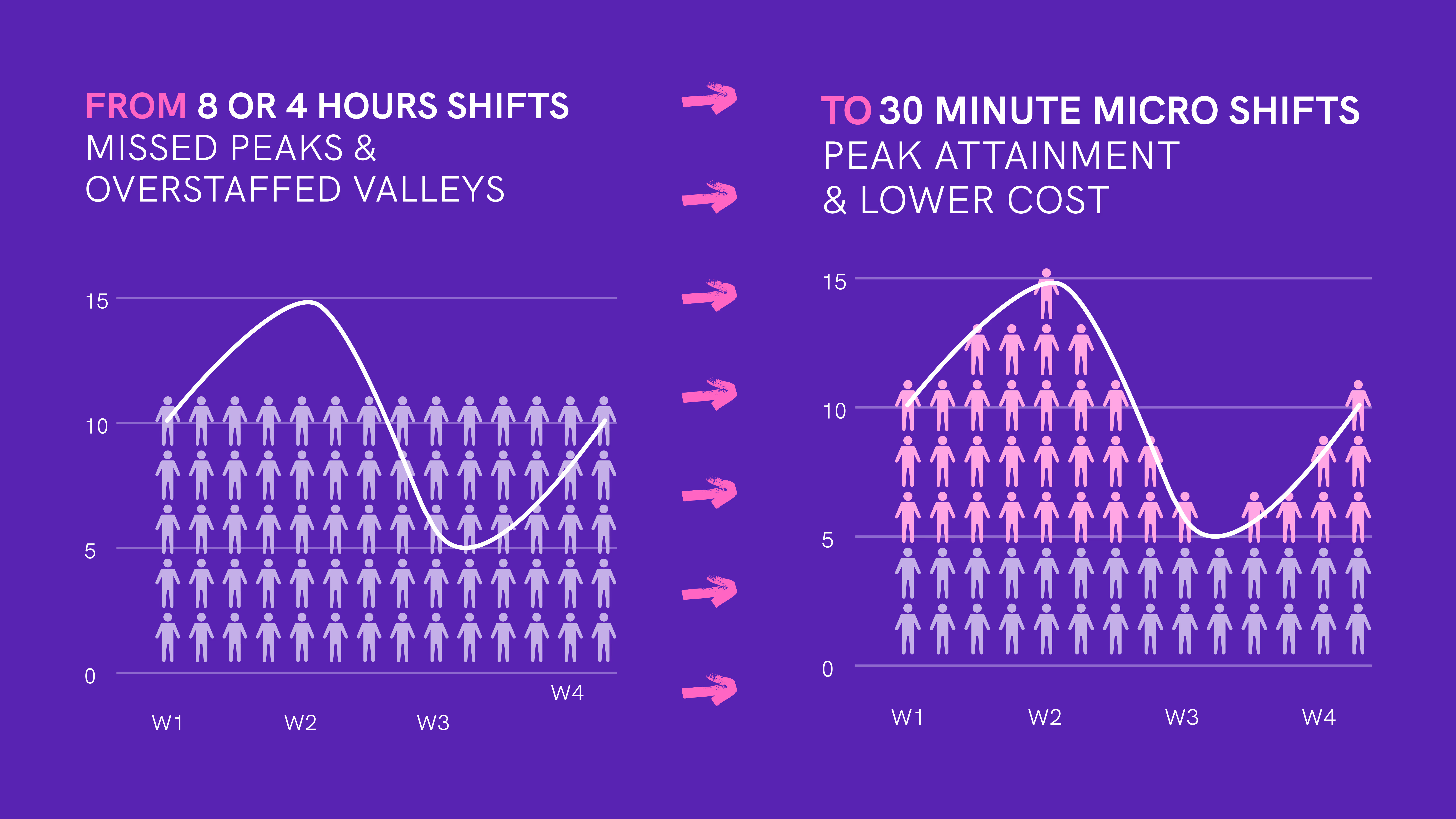
A traditional outsourcing solution isn’t flexible enough to flex FTE talent to meet customer demand. Companies are paying for the lack of flexibility on both ends as they can’t scale down FTE talent without creating a poor agent experience or scale FTE talent up when they have unpredictable surges or busy seasons.
GigCX is not only flexible for contact centers but also for agents. This model enables gig agents to create a schedule that works around their schedule and positions them to have full control of their earning potential. This model attracts high-quality agents who are passionate about this work because it aligns with their expertise and lifestyle.
GigCX is more than a trend. It’s the future of contact centers as we know it. The flexibility this outsourcing solution provides works for both call centers and contact centers. When it comes to outsourcing, we predict more call centers and contact centers will adopt a tailored blend of GigCX outsourcing, in-house tools, and AI-assisted technology to create memorable and profitable customer experiences.
Interested in using GigCX outsourcing for your contact center, contact our team here.
Frequently Asked Questions
What is the difference between call center and contact center outsourcing?
Call center outsourcing handles only phone calls (inbound and outbound), while contact center outsourcing manages multiple channels including phone, email, social media, live chat, and forums.
Is call center outsourcing less expensive than contact center outsourcing?
Yes, call center outsourcing is typically the least expensive option because it focuses exclusively on voice calls and often leverages offshore talent to keep costs low.
When should I choose call center outsourcing over contact center outsourcing?
Call center outsourcing makes sense if phone calls are your only customer support channel, but if you plan to expand to other channels, contact center outsourcing is a better long-term choice.
What is the difference between offshore call centers and BPOs?
Offshore call centers handle specific tasks like answering calls, while BPOs manage entire call or contact center operations including workforce planning, resource management, and agent training.
What is GigCX and how does it differ from traditional outsourcing?
GigCX leverages independent contractors or freelancers to provide on-demand customer support, allowing companies to scale capacity up or down to match customer demand perfectly, unlike traditional outsourcing which lacks this flexibility.
Can traditional BPOs handle modern contact centers with multiple channels?
Most BPOs are experts at operating call centers but aren't designed to manage complex contact centers with multiple support channels and unpredictable customer needs on their own.
Why do modern contact centers need more than just a BPO or outsourced call center?
Modern contact centers often require a blend of outsourcing solutions, in-house teams, and technologies like AI chat or GigCX to create a stellar customer experience across multiple channels.
What are the limitations of BPOs for contact centers?
BPOs fall short because they don't have the model to flex outsourcing capacity on demand, which creates challenges for businesses with volatile seasonality or hard-to-predict customer needs.

Explore more of our Blogs



%2520(1)%2520(1).avif)

.avif)
.avif)

.avif)


.avif)


.avif)


%2520(2).avif)

.avif)
More of our Resources
Our Blogs
The solution has been deployed across more than 125 tourism organizations
Our Webinars
The solution has been deployed across more than 125 tourism organizations
Our Guides
The solution has been deployed across more than 125 tourism organizations
Our Stories
The solution has been deployed across more than 125 tourism organizations
Our Podcasts
The solution has been deployed across more than 125 tourism organizations
Our Events
The solution has been deployed across more than 125 tourism organizations