Key takeaways
- Outsourcing live chat means hiring a third-party support team to handle real-time customer requests.
- It’s crucial to define the service scope and optimize training materials.
- Modern-day live chat outsourcing combines human agents with automation tools.
- Outsourcing efficiency is measured through performance reports and chat transcripts.
- Live chat outsourcing price depends on the service model, training, and tool integration.
Outsourcing live chat support is one of the best moves your organization can make to maintain high responsiveness and quality customer relations. Especially if you’re dealing with hundreds of tickets per day, hiring a third-party team of experts can make a big difference.
The only problem is that most managers and business owners who are curious about how outsourced live chat works assume you just appoint a company and leave it all to them. In reality, much of it comes down to preparing and working with the vendor to ensure maximum customer satisfaction.
This guide will point you in the right direction by explaining why appointing a renowned company like ShyftOff as the lead of your outsourced live chat team is important.
What Is Outsourced Live Chat?
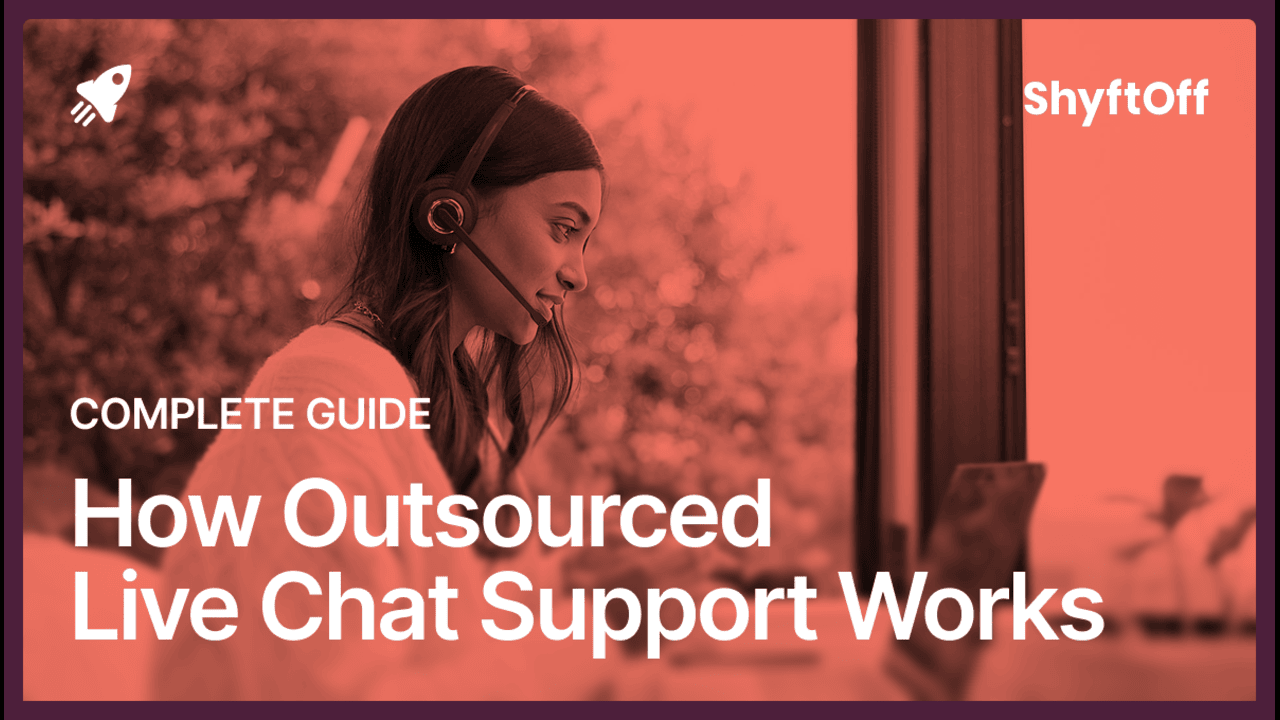
Outsourced live chat refers to hiring a third-party support team to handle customer interactions on your behalf. It’s a more effective alternative to training an in-house support team or adopting full AI automation, both of which often result in poor customer satisfaction scores.
In an outsourced live chat system, human support representatives handle customer requests in real time. It’s a different approach from standard ticketing systems, where customers submit a request and wait for an email response.
This real-time response makes a difference: customers can rely on instant, detailed solutions to their problems. Outsourced live chat saves you the cost and trouble of running an in-house team with 24/7 availability.
It’s also a high-value conversion tool, as timely responses resonate with readers when they make crucial purchase decisions, read product reviews, and review specifications.
What Outsourced Live Chat Agents Do
Outsourced live chat agents do more than just answer questions in real-time. Here’s an overview of their core responsibilities:
- Responding with approved language and scripts: Live chat agents handle customer interactions based on your inputs, response templates, and predefined greetings. They ensure alignment with your brand’s tone of voice and guidance, just like an in-house team.
- Qualifying and troubleshooting issues: Agents also help diagnose potential problems that customers are facing beyond AI responses, or point them to your existing knowledge databases or help articles. They are trained to recognize the limits of their authority, so you can expect them to delegate important matters back and properly escalate.
- Tagging and documenting interactions: As an employer, you can oversee all customer communication through detailed CRM logging or direct input into your help desk system.
- Maintaining response quality: Even though chat agents may handle multiple conversations simultaneously, they do so in accordance with your support guidelines, with a strong focus on service quality.
- Supporting lead capture and sales routing: For sales-based companies, outsourced chat agents use pre-set questionnaires to qualify leads and route prospects to sales teams.
Important note: Third-party live chat teams don’t necessarily handle everything on their end. Major vendors like ShyftOff act more like partners and extensions of the in-house team, with ticket rerouting when governance and onboarding are prioritized.
How Outsourced Live Chat Works: A 5 Step Guide
There’s more to live chat outsourcing than just browsing available vendors and choosing one. This detailed guide will cover all the steps of their operation to help you find a tailored option:
Step 1: Define Scope & Success Criteria
The crucial start to the process is establishing your goals and boundaries based on these parameters:
- Coverage hours: Ask the following questions: Do you need the chat to run 24/7 or only during business hours? How vital is multi-lingual coverage in your target customer niche? If your business operates in multiple countries, that means you’ll also need to translate the training materials.
- Support tier: Tier 1 agents respond only to common questions and perform basic troubleshooting. Tier 2 involves handling technical escalations, while Tier 3 support handles sensitive customer information, lead qualification, and interactions with sales management.
- Live chat goals: Set specific targets for customer satisfaction (CSAT) scores in advance. This also includes response time, which is typically under a minute for efficient live chat support. Document your goals as measurable SLAs and use them to evaluate the outsourced team's performance.
- Volume forecasting: While outsourced live chat teams can handle multiple queries at once, you should set basic volume expectations. This helps prevent chaotic situations during seasonal spikes.
Step 2: Build Playbooks & Scripts
Documentation is key to ensuring agents are aligned with your expectations. We recommend starting with detailed playbooks that agents will use as guidance for handling specific situations.
Greeting flows are essential for creating the desired first impression in your brand’s voice. Macros and response templates help agents stay cohesive and speed up the process.
You should also set up escalation rules and ensure that all responses are based on your inputs and scripts.
Note: While LLMs and templates help standardize responses, human agents still need technological assistance and documented guidelines to prevent having to read between the lines when interacting with customers.
Step 3: Tooling & Technical Integration
Your outsourced live chat team needs a technical foundation to do the job right. Modern partners like ShyftOff’s aligned workflows emphasize early-stage readiness checks:
- Live chat platform selection: You should first choose a support platform that supports agent routing. Popular options include Intercom, Zendesk Chat, LiveChat, and Drift.
- CRM and helpdesk integration: Ticket escalations and customer follow-ups should be handled consistently to ensure a seamless integration with your existing CRM and ticketing system.
- Access controls and security: To protect customer data, never grant admin access to live chat agents. The best way to approach this is by setting permissions and role-based access controls.
- Monitoring dashboards: Visibility is crucial for performance reviews, so set up dashboards that display CSAT scores, response timeframes, and agent availability.
Step 4: Training & “Nest” Period
Training the outsourced team isn’t a one-time thing. Instead, it should be done consistently, with a focus on:
- Brand voice orientation: The agents first need to learn your brand’s voice guidelines, target customers, and the overall communication style. Establishing an escalation route is also crucial to ensure they interact appropriately.
- Product knowledge and process training: Agents should be familiar with product descriptions, features, and common customer pain points.
- Shadowing internal staff and supervised chats: One of the most effective training methods is to appoint experienced agents as real-time supervisors to provide instant feedback to outsourced team members.
- Ramping up milestones before independent handling: Set clear criteria for quality reviews of supervised agents and establish capability overviews before you leave them to work independently.
Step 5: Go-Live & Optimization
With the scope determined and integration and training complete, the next step is to make the necessary adjustments as the support goes live:
- Start with conservative concurrency limits: Until they prove they can handle higher loads, ensure that all agents handle up to 2 concurrent chats.
- Review daily during the early stages: It’s vital to spot potential problems early by reviewing chat transcripts, identifying quality issues, and updating playbooks based on potential queries that leave agents overwhelmed.
- Update playbooks and macros: Customers may ask questions not covered in the documentation. In such situations, ensure agents can work with supervisors and learn how to handle unique inquiries.
- Establish feedback loops: It’s all about feedback when it comes to maintaining customer service quality. Create dedicated channels for outsourced agents to interact with internal team members, and do the same for policy updates or potential dynamic changes.
Tools & Tech That Make It Work
For a successful outsourced live chat operation, you’ll need an integrated technology stack, consisting of:
- Live chat platform: The platform comprises the widgets customers see and the console used by outsourced agents. Make sure to choose one based on visitor tracking features, chat routing, file sharing, and mobile accessibility.
- Helpdesk/CRM integrations: Connect chat interactions to customer records and support tickets via direct integration, ensuring agents can see order history and previous interactions.
- Chat routing/automation: This ensures that specific inquiries reach the appropriate agents. Routing rules should be based on key factors such as visitor location, page type, support tier, and other criteria.
- Analytics/dashboard tools: Using proper analytics and dashboard tools helps track performance metrics and identify trends. Ideally, it should display agent availability and real-time queue insights.
- Knowledge base/reference hub: The knowledge base provides quick access to troubleshooting guidelines and policy documents, helping agents resolve issues faster.
Best practice tip: Ensure your outsourced team can deliver insights, not just handle conversations. Provide them with adequate reporting tools and establish processes for sharing query themes, customer feedback patterns, and suggested improvements.
KPIs & SLAs That Matter
This overview will show you which metrics are crucial for evaluating the performance of an outsourced support team:
- First response time (FRT): This metric measures how quickly agents respond after a customer starts a chat. Anything longer than 30 seconds is considered slow by today’s live chat support standards.
- Chat containment rate/resolution in live chat: Measures the percentage of chats resolved without any escalation of tickets to other channels. A high level of containment is a positive sign that agents can handle issues independently.
- Customer satisfaction (CSAT): A basic performance metric, this score reflects overall customer satisfaction on a 1-5 rating scale.
- Escalation rate: This one shows the percentage of chats delegated to internal teams. It indicates whether agents may need additional training or greater decision-making authority.
- Average handle time (AHT): AHT reflects the balance between response time and quality of service.
Other metrics that teams commonly overlook include reporting cadence and quality scorecards with weekly performance reports and monthly calibration sessions.
Pricing Models for Outsourced Live Chat
The estimated costs of outsourcing customer service, and live chat in particular, don’t depend solely on the model. You should also consider investments in training, ramp-ups, custom workflows, and the tools and platforms you use. Other than that, these models commonly dictate the price:
- Per agent/per hour: A fixed hourly rate that enables predictable staffing costs and supports expense forecasting.
- Per interaction/per ticket: This fee is charged for each chat handled, whether it’s long, short, simple, or complex. Simply put, you’d be paying for each customer interaction.
- SLA/results-based pricing: This one is performance-based, as you’d be paying lower base rates with the chance of exceeding them in case of positive CSAT scores.
- Blended/retainer models: A combined model makes sense if you generally wish to pay a regular hourly rate, with a per-interaction boost during peak periods.
Human Agents vs Chatbots: How They Work Together
The combined framework of human representatives supported by chatbots helps reduce agent fatigue by delegating simpler tasks to automated channels. Here are a few implementation examples:
- Bot first: The best option for simple FAQ interactions and lead capture. Chatbots are well-suited to simple questions with fixed answers, and they can also collect basic information, such as business hours or shipping costs, and relay it to the human team of agents.
- Human fallback for nuance and judgment: Whenever bots detect frustration or a conversation leading nowhere, they can delegate tickets to the team of agents.
- Collaborative automation: The combined approach leverages AI-powered suggestions for simple responses and human assistance for Tier 2 and other technically complex queries.
Common Challenges & How to Solve Them
Live chat outsourcing works best when internal teams own governance, with the third-party team handling customer interactions within previously defined frameworks. Not sticking with this approach can lead to issues down the line, such as inconsistent brand voice when agents interpret tone guidelines differently. Dealing with this requires investments in detailed tone guides with examples, as well as regular QA reviews.
One of the biggest potential problems is giving customers incorrect answers, which can damage the brand’s reputation and erode customer trust. That’s why clear escalation guidelines should be in place.
Understaffing during peak season can be addressed through simple pre-planning and forecasts based on historical data, while issues such as poor reporting can be avoided by implementing structured metrics and regular performance reviews.
How to Choose a Live Chat Outsourcing Partner
To find the right outsourced live chat vendor, systematically evaluate potential partners. Here’s a checklist to help guide your decision:
- Training and onboarding depth: Confirm whether potential partners have structured training materials or rely solely on the documentation you provide.
- QA and calibration approach: Inquire about how they measure quality and success. Do they feature regular performance reviews, and how are nest periods handled?
- Transparency in reporting and access to chat transcripts: Ask if you can access chat transcripts directly or if they’ll just provide you with summary reports. State the importance of having real-time dashboard access.
- Tech stack compatibility & security posture: Do they have prior experience working with your selected chat platform and CRM? What security certifications do they hold?
- Scalability for peaks and campaigns: How do they handle seasonal spikes, and how quickly is new agent onboarding handled?
The cheapest option can quickly become the most expensive due to poor service quality and frequent adjustments. This is why partners focused on rigorous processes and integration, such as ShyftOff, prioritize these operational fundamentals.
Frequently Asked Questions
How does outsourced live chat work?
Outsourced live chat involves a third party handling your customer chat conversations in accordance with your playbooks and brand guidelines.
What tools does outsourced live chat require?
The main tools required for live chat outsourcing include a chat platform, CRM/helpdesk integration, a knowledge base, and reference materials. You also need analytical dashboards and reporting tools.
How long does it take to train outsourced chat agents?
In most cases, training outsourced chat agents takes between 1 and 2 weeks, with the supervised “nest” period requiring another week or two.
What are common KPIs for outsourced live chat?
Key metrics include first-response time, chat containment rates, CSAT scores, escalation rates, and average handle time.
Is outsourced live chat cheaper than in-house?
Yes, outsourced live chat is usually cheaper than training an in-house team of agents. Still, you should consider other costs besides fixed ones, such as hiring, training, onboarding, and quality control.
How do bots and humans work together in live chat?
Bots mainly handle FAQs and simple questions with pre-set answers, while Tier 2 and other demanding queries are delegated to human agents.
What SLAs should I use for outsourced live chat?
You should use SLAs like first response within 30 seconds, CSAT scores over 90%, and chat containment rates above 80%.

Explore more of our Blogs


%2520(1)%2520(1).avif)

.avif)
.avif)
.avif)


.avif)


.avif)

%2520(2).avif)

.avif)
More of our Resources
Our Blogs
The solution has been deployed across more than 125 tourism organizations
Our Webinars
The solution has been deployed across more than 125 tourism organizations
Our Guides
The solution has been deployed across more than 125 tourism organizations
Our Stories
The solution has been deployed across more than 125 tourism organizations
Our Podcasts
The solution has been deployed across more than 125 tourism organizations
Our Events
The solution has been deployed across more than 125 tourism organizations