Key takeaways
- Outsourcing is a scalable option for growing businesses that need 24/7 support.
- Outsourcing is a more cost-effective alternative to training an in-house team.
- ShyftOff enables contact centers to scale customer support agents in just a few clicks, without relying on a traditional BPO model.
Customer support is the cornerstone of every business and a foundation for building strong relationships with your customers. However, scaling it can be challenging, especially for fast-growing companies that lack the capacity or headcount to keep up.
As a result, running an in-house customer service operation with around-the-clock availability often becomes unsustainable. It’s no surprise that many founders, CX leaders, and operations managers ask themselves how to outsource customer service. Is this truly an effective solution, or just a cheaper way of running things?
If that sounds familiar, this guide will walk you through the essentials. We’ll explore what customer service outsourcing really is, how it works, and how to select the best external team for your business.
What Does It Mean to Outsource Customer Service?
In simple terms, outsourcing customer support means using third-party support teams to handle customer interactions on your behalf. It’s an alternative to building and managing an in-house support team, as customer service outsourcing vendors bring the people, processes, and technology to your business.
They provide the infrastructure and tools you need and handle similar tasks to what an in-house team would do. Outsourced support agents still represent your brand, follow your policies, and work as an extension of your team in customer-facing channels.
Customer service outsourcing is often most effective for handling high-volume, Tier 1 requests, while in-house teams focus on escalations and complex issues. Unlike most BPOs that are optimized primarily for simple support, ShyftOff specializes in experienced agents who can manage both routine inquiries and more complex customer interactions, giving teams greater flexibility in how they structure support.
As customer service outsourcing has evolved, it’s no longer one-size-fits-all and can now be tailored to each business’s needs. Your brand remains front and center, while your outsourcing partner handles hiring, training, scheduling, and HR in the background.
Why Companies Choose to Outsource Customer Service
Simply put, outsourcing customer support helps cut costs and improve operational efficiency. Here are some of the main reasons successful companies outsource their support:
- Lower running costs: Running an in-house support team requires significant investment in salaries, benefits, management overhead, tools, and even office space. With outsourced support, you get similar (or better) service quality without carrying all those fixed costs.
- Around-the-clock coverage: Support demand doesn’t always fit neatly into business hours. Outsourcing to a partner that offers 24/7 coverage ensures there’s always someone available to help your customers, maintain trust, and protect your brand.
- Increased scalability: Support volume can spike due to seasonality, promotions, or product launches. A scalable outsourcing provider lets you flex up and down with demand, so you’re not overstaffed during quiet periods or overwhelmed during peaks.
- Local or multilingual support: With the right vendor, you can tap into agents who understand local markets, languages, and cultural nuances, or offer multilingual support without hiring separate teams internally.
- Access to specialist expertise: Outsourcing gives you instant access to trained, experienced support professionals who live and breathe customer service, which means they’re often more reliable and effective than brand-new in-house hires.
Of course, there are also reasons to be cautious. It’s harder to manage quality control when support agents don’t sit in your office. There are also risks related to brand consistency, tone of voice, and language if the partnership isn’t well set up.
Benefits can also vary by company size. Startups can quickly stand up a professional support function without building it from scratch, while enterprises can cut hiring and training costs, cover more time zones, and standardize support across regions.
When Should You Consider Outsourcing?
The decision to outsource customer support depends on your growth plans, operations strategy, and CX goals. It’s not the right move for every company, but there are clear signals that it might be time to explore this option:
- Business growth is outpacing your current in-house support capacity.
- Customers are experiencing long wait times or delayed responses.
- Running an in-house team becomes financially unsustainable.
- You need specialized expertise or new channels (e.g., live chat) fast.
- Your brand is expanding and needs multilingual or region-specific support.
When done well, outsourced customer support can relieve budget pressure and free your internal teams to focus on higher-level CX initiatives, product improvements, and strategic projects. It can also help you implement more efficient workflows and build a consistent feedback loop between customer interactions and your product, marketing, or operations teams.
For example, imagine an eCommerce wellness brand that suddenly sees a surge in sales. The situation becomes overwhelming for its internal support team, eventually leading to delayed responses and dissatisfied customers.
In this case, it makes sense to hire a team of outsourced eCommerce support experts to help the business quickly absorb ticket volume, stabilize response times, and scale coverage based on performance and seasonality.
Step-by-Step: How to Outsource Customer Service
While there are many benefits to outsourcing customer service, there are also lots of things that could go wrong. You can follow these steps to ensure staying on the right track and avoiding poor-quality third-party services:
Step 1: Define Your Goals and Scope
Start by setting clear objectives, such as reducing support costs by a specific percentage, improving CSAT, or moving to 24/7 coverage in key channels. Then define the exact scope of work you want to outsource.
You’ll choose a provider based on your business goals and service-level agreements (SLAs). These are essential for stating your expectations up front and avoiding unpleasant surprises later.
Step 2: Choose the Right Outsourcing Model
There are several models to consider, starting with offshore outsourcing by partnering with providers that manage teams from countries with lower labor costs. They usually offer a great mix of expertise and cost-effectiveness.
Another option is onshore outsourcing, partnering with providers in your country to stay on the same page in terms of culture and language preferences.
You can also explore flexible outsourced support options and only pay for work done when the volume of inquiries is higher. Or, get the best of both worlds with a hybrid model. The choice is all yours.
Step 3: Create a Vendor Shortlist and Evaluate Providers
To create a shortlist of service providers, you should follow a strict set of criteria. Focus on industry experience, preferably with other companies in your field of expertise. Check and compare the pricing plans and potential hiring/training fees, and evaluate available tools, channels, and support equipment.
You should tread extra carefully, especially with providers offering extremely low prices. Also, a lack of transparency, vague contracts, or no clear onboarding and reporting process can all signal future problems. After this vetting, you should be left with a shortlist of three to five serious contenders.
Step 4: Ask the Right Questions Before You Sign
Next comes the evaluation and interview process. You’re effectively hiring an outsourced extension of your team, so you need to dig into how they operate.
Make sure to ask the right questions about quality control and assurance, data security, compliance, flexibility, performance-tracking tools, and contact terms. For example:
- How do you run quality control and assurance within your team?
- How do you handle underperforming agents?
- How do you ensure compliance with GDPR, CCPA, HIPAA, and other regulatory frameworks?
- What security certifications do you have?
- How quickly can you scale up support if inquiries suddenly spike?
- How do you track performance share reporting?
- How do you handle agent onboarding to align with our brand’s values and culture?
- What’s the minimum contract term?
- Are there any setup, hiring, or training fees?
Step 5: Plan Your Onboarding and Knowledge Transfer
Once you’ve made up your mind, you’ll need to provide the right tools and brand-related knowledge to help with the onboarding. Make sure to create detailed documentation that captures your brand’s voice and language, along with tone guidelines and communication standards.
You can also create tutorials, guides, playbooks, and other materials to help with agent training and setup.
Step 6: Monitor, Optimize, and Scale
From there, you can track key performance metrics such as average response time, resolution time, customer satisfaction ratings, and more. Evaluate the performance of the outsourced team, provide feedback, and optimize and scale the support service adequately.
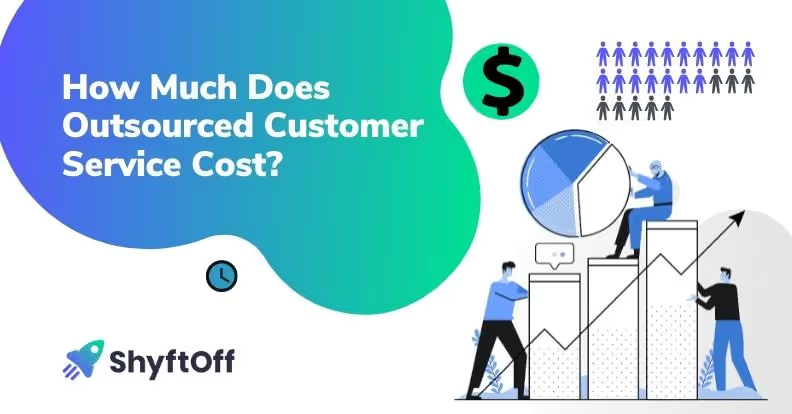
How Much Does It Cost to Outsource Customer Service?
The cost of using an outsourced support team varies depending on complexity, available channels, and the model used. In general, offshore teams are more cost-efficient than in-house and onshore teams.
While pricing might vary drastically, you’re looking at between $8 and $15 per hour for offshore providers. That cost could go up to $30 for nearshore providers (such as agents in the Bahamas for the US market), or even $60 for onshore and local teams. Omnichannel support usually comes at a premium.
Best Practices for Successful Customer Service Outsourcing
- Focus on quality rather than volume: Ensure quality remains at the center of your KPIs. Track CSAT, QA scores, and first-contact resolution, and not just handle time.
- Assign an internal liaison: Designate someone inside your company as the main point of contact for the outsourced team. This person coordinates feedback, shares updates, and keeps everyone aligned on goals.
- Establish clear language and cultural guidelines: Clearly define your brand voice, tone, and language preferences early on so the team consistently represents your company in the best light.
- Provide comprehensive documentation: Keep documentation updated as products, policies, and processes change.
- Optimize based on performance data: Use performance reports, customer feedback, and QA results to refine scripts, workflows, staffing levels, and training priorities over time.
Common Mistakes to Avoid
- Choosing the cheapest provider just to cut costs: Sometimes, going with the cheapest option can prove quite costly in the long run. Always balance price with quality, track record, and cultural fit.
- Setting unclear expectations: If you don’t set clear SLAs, documentation, and goals from the start, you risk misaligned support and poor customer experiences.
- Having a purely transactional relationship: Treating the support vendor like a partner helps you translate common goals into practice.
- Failing to review tickets regularly: There could be huge discrepancies in customer satisfaction from one ticket to another. Failing to notice them early on could lead to mixed customer response and potentially drag down your sales.
Spotlight: How ShyftOff Reinvented Customer Service Outsourcing
Customer service differentiation has become a key competitive advantage, and providers like ShyftOff excel in that category.
As an Agentic Workforce Delivery Platform, ShyftOff uses flexible models to help businesses scale their support intelligently. Unlike traditional BPOs that focus on seat counts, ShyftOff enables contact centers to scale outsourced support to meet quality and performance with transparency.
ShyftOff enables contact centers to flexibly scale US-based agents at 35–55% lower cost than building an internal team or working with traditional BPOs. Its automated workforce delivery platform is designed to scale support around your existing W2 and AI agents, ensuring the right number of agents are staffed at any given time to consistently meet SLAs, without excess overhead or rigid staffing commitments.
With this service, you can scale up support efforts during peak season and scale down between spikes. It’s a flexible solution with pay-for-performance options, modern analytics, and real-time dashboards with customer satisfaction insights.
Final Thoughts: Is Outsourcing the Right Move for You?
At the end of the day, customer support outsourcing in 2025 does come with major benefits, but it can also be a risky move to pull if you don’t thoroughly check vendors first. While it promises higher cost efficiency, faster response times, and greater scalability, it can also drag your customer satisfaction down if you make the wrong choice.
With proper documentation, SLAs, and quality assurance, you can do your company and its customers a great favor. It’s not just about choosing the most affordable provider, but about creating a sustainable support model for years to come.
Ready to see how outsourcing support could benefit your business? Get in touch with ShyftOff experts for a quote and learn more about the leading agentic workforce platform.
Frequently Asked Questions
How long does it take to fully switch to outsourced support?
The integration period depends on your preferred model and complexity, but most businesses can switch to fully outsourced support within 3–6 months, including the hiring process, onboarding, and launch.
What’s the minimum typical contract length?
Most traditional BPOs operate on annual contracts, with minimum commitments of one to three years. ShyftOff removes this rigidity by offering a platform-based model that allows contact centers to scale support without locking into long-term agreements.
Can I outsource specific channels only?
Yes, you can outsource specific channels, such as live chat and phone support, while leaving others, such as email support, managed in-house.
How much control will I have over the outsourced team’s performance?
The level of control over the support team depends on your contract structure and plan. If you regularly review support tickets and customer feedback, and provide helpful documentation and SLAs, you can have a say in everything that goes on.
When should I consider outsourcing customer service?
Consider outsourcing when business growth outpaces your support capacity, customers experience long wait times, running an in-house team becomes financially unsustainable, or you need specialized expertise or multilingual support quickly.
How do I choose the right customer service outsourcing provider?
Evaluate providers based on industry experience, pricing transparency, available tools and channels, data security and compliance certifications, quality control processes, scalability, and contract flexibility.
How do I maintain quality with an outsourced team?
Maintain quality through clear SLAs, comprehensive documentation, structured onboarding, regular QA sessions, performance tracking with KPIs like CSAT and first-contact resolution, and ongoing communication with your provider.

Explore more of our Blogs






%2520(1)%2520(1).avif)


.avif)
.avif)

.avif)


.avif)


.avif)



%2520(2).avif)

.avif)
More of our Resources
Our Blogs
The solution has been deployed across more than 125 tourism organizations

Our Webinars
The solution has been deployed across more than 125 tourism organizations
Our Guides
The solution has been deployed across more than 125 tourism organizations
Our Stories
The solution has been deployed across more than 125 tourism organizations
Our Podcasts
The solution has been deployed across more than 125 tourism organizations
Our Events
The solution has been deployed across more than 125 tourism organizations