Key takeaways
- Offshore, nearshore, and onshore outsourcing models have specific trade-offs in terms of pricing, availability, and market coverage.
- Outsourcing to offshore regions might make the most financial sense, but customer satisfaction should still be a priority.
- Outsourcing customer service to only one region leaves your business vulnerable to shifts in customer demographics.
- Agentic Workforce Delivery Platforms like ShyftOff bridge the cultural gap by connecting globally sourced agents with specific markets.
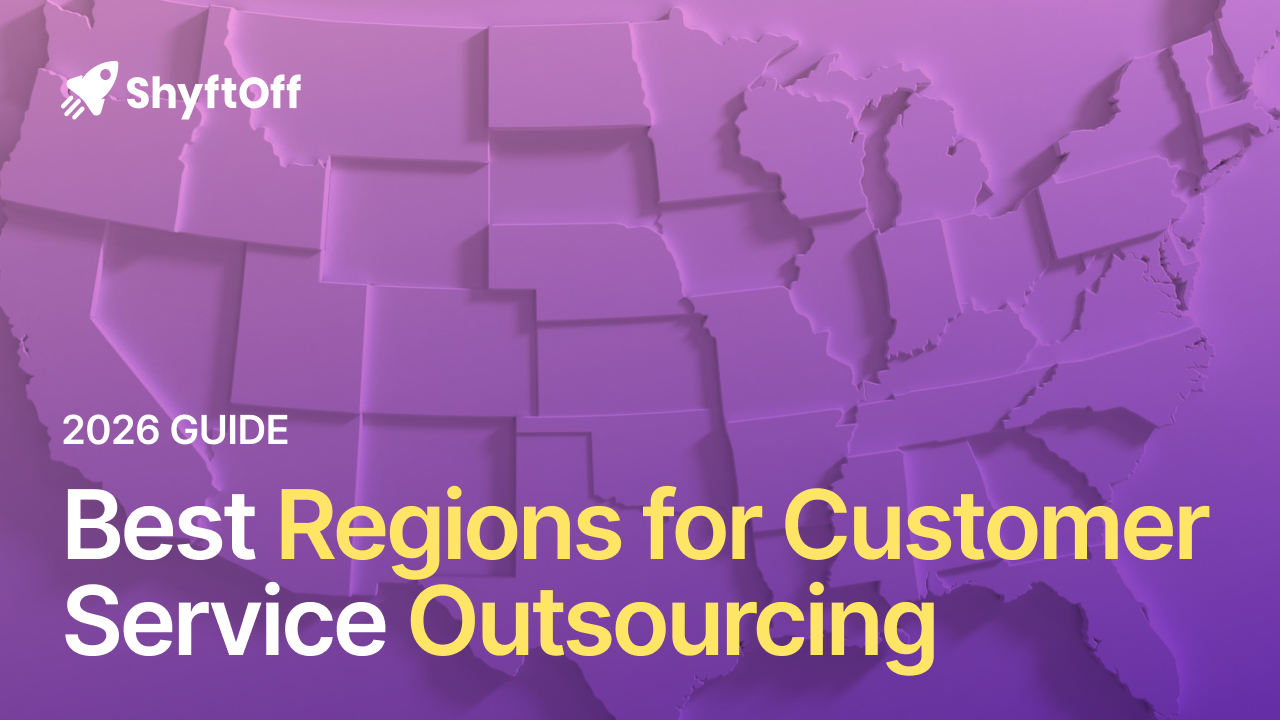
Customer support is a vital component of every business, as it can make or break the brand’s reputation with customers and clients. Businesses that invest in seamless and responsive support experiences are more likely to retain clients, but there comes a point when an in-house team simply can’t keep up any longer.
In such cases, customer service outsourcing is the best option, as long as it’s done right. If that’s something you think your business would benefit from, there’s one big question to address before you choose the vendor: What are the best customer service regions, and is the region relevant in keeping costs low without compromising the quality of service?
To put it simply, yes, there are subtle differences among the main outsourcing regions, including pricing, market familiarity, and specific time zone availability. In this guide, we’ll expand a bit on how offshore customer service works and which regions to prioritize based on your business needs.
Why Region Matters in Customer Service Outsourcing
When it comes to outsourcing customer service, the total cost of outsourcing customer service is the first thing that comes to mind. Still, it should be a strategic decision, and not just a cost-saving effort.
The region from which customer support representatives are sourced has a significant impact on the customer experience and shapes your brand's perception across markets. It’s a huge plus to have a team of native support experts who are culturally aligned with the market you sell your products and services in.
This allows you to have 24/7 support coverage outside of your in-house team’s time zone and availability. Most importantly, outsourced teams are scalable, so you can hire more agents as your company grows and during peak demand.
Naturally, outsourcing is also more affordable than training an entire team of experts yourself. For instance, LATAM-based support agents are familiar with the US market, and they work during North American business hours at a fraction of the cost of hiring a native agent.
How We Evaluated Customer Service Outsourcing Regions
Our regional recommendations were made using a multi-factor methodology to evaluate customer support options for businesses in 2026. Here’s what we considered:
- Talent availability & workforce depth: We checked the talent pool for each region touched upon in this guide.
- English proficiency and language coverage: We considered only regions with high levels of English proficiency, with a focus on neutral accents and a wide vocabulary.
- Cultural compatibility with Western markets: This refers to how well an agent understands the North American market, business norms, and customer expectations.
- Cost efficiency vs. service quality: Hidden fees and contract terms only add to the existing expense of running an outsourced team, so we calculate the total cost.
- Time zone alignment: We also looked for regions compatible with working in the US time zone and during North American business hours.
- Infrastructure & tech readiness: Remote work capabilities, security standards, and platform integrations are technical aspects we thoroughly checked for each region.
- Data security, compliance maturity, and stability: We assessed these with particular attention to markets such as healthcare and financial services.
- Scalability for fast-growing companies: Finally, we explored how quickly agents in these regions can join a team without compromising service quality.
Best Regions for Customer Service Outsourcing
Based on the factors above, as well as common regions from where customer service outsourcing companies pull their agents, we did a deep dive into the most common areas:
Latin America
Latin America has been one of the top destinations for US companies outsourcing customer support for years. The nearshore nature means real-time availability during peak business hours, same-day escalations, and no handoff delays.
Another major contributing factor is that Latin American representatives are well immersed in American culture and business trends. Many live or study in a bilingual environment, using English daily from a very early age, giving them the ability to provide nearly native-level support at a fraction of the cost.
- Best use cases: SaaS, eCommerce, fintech, subscription businesses
- Key advantages: North American cultural literacy and a focus on empathy and soft communication skills
- Potential limitations: Higher per-hour rates than regions like Southeast Asia
- Ideal company profile: Mid-size, growth-stage American businesses that prioritize quality support over cost savings
Eastern Europe
Eastern European agents have continuously proved themselves valuable even for Tier 2 support requests. They learn English through a robust education system from an early age, so they have the market knowledge and technical background for more serious troubleshooting.
Customer service representatives in this region are widely regarded for their familiarity with EU data protection and privacy laws. They excel in remote work capability and reliability.
- Best use cases: Technical customer support, regulated industries, B2B services
- Key advantages: High English proficiency, strong technical skills, and compliance awareness
- Potential limitations: Time gaps with the US West Coast require careful scheduling
- Ideal company profile: Tech and B2B SaaS companies in regulated industries requiring compliance-aware support
Southeast Asia
Support hubs like the Philippines, Vietnam, and Indonesia have earned a solid reputation for resolving Tier 1 and Tier 2 customer requests. Filipino agents are particularly known for their high level of English proficiency and service-oriented approach.
Years of exposure to American media have brought US culture closer to these markets. While the talent pool for BPOs is enormous in this region, companies like ShyftOff excel at offering on-demand support with highly trained representatives whose level of business support knowledge is on par with in-house teams at American companies.
- Best use cases: Large-scale customer support operations, omnichannel support
- Key advantages: Vast talent pool, competitive pricing, cultural alignment with Western markets
- Potential limitations: Time zone gaps, lack of capability to handle Tier 3 escalations
- Ideal company profile: Enterprises and growth-focused companies looking for scalable support at volume
South Asia
South Asian countries like India produce millions of support agents with college-level education and English skills expected of native speakers. Agents from this country are well-versed in the tech space, and the wide talent pool also means competitive pricing.
The South Asian ecosystem is also renowned for high levels of management and customer relations training. Main fields of expertise include technology, finance, and business operations.
- Best use cases: Enterprises needing volume and long-term scale
- Key advantages: Great workforce scalability, competitive pricing for large volumes
- Potential limitations: Cultural tone differences
- Ideal company profile: Large businesses in need of high-volume support at scale
Africa
Africa is the emerging customer support region to watch in 2026. Agents from countries like South Africa, Egypt, and Kenya are invested in the digital infrastructure, and an English-speaking workforce with high accent neutrality is always a plus.
It’s a solid entry point into outsourced customer service, with long-term talent supply and pricing that's much more affordable than in regions like LATAM.
- Best use cases: Early-stage companies testing outsourcing models
- Key advantages: Great cost-to-quality ratio, cultural alignment with English-speaking countries
- Potential limitations: Varying compliance maturity and less-established BPO systems
- Ideal company profile: Growing businesses just starting to explore customer service outsourcing options
Onshore & Hybrid Models
Sometimes, geographical alignment is not optional, especially in regulated industries like finance and healthcare. Companies in these spheres often require onshore agents to deliver tailored customer experiences for sensitive interactions.
The difference between training an in-house team and hiring onshore individuals is in the model and approach. Companies that would benefit from a hybrid model, with native agents handling Tier 1 and Tier 2 support and nearshore support for after-hours service, get the most out of this approach.
- Best use cases: Financial services, healthcare-adjacent support, high-touch CX
- Key advantages: Complete cultural and language alignment, compliance readiness
- Potential limitations: Higher cost per interaction than with offshore models
- Ideal company profile: Regulated industries, premium brands, businesses handling sensitive customer interactions
Common Mistakes When Choosing an Outsourcing Region
Not every region is suitable for businesses looking for every form of support. That’s why we’ve made a summary of things to look out for to help you avoid making a mistake initially:
- Choosing based on cost alone: Cutting the cost of training an in-house team may not be worth it if CSAT scores drop and customers move away from your brand.
- Ignoring scalability and attrition risk: Some regions have strong talent pools on paper, yet struggle to retain experienced agents. If a vendor constantly churns agents, ask yourself if that’s what you want for your business from a stability standpoint.
- Overlooking cultural and tone alignment: Some industries require agents to read tonal cues and cultural norms when interacting with customers, and that’s not something you’re likely to get with offshore regions that are not aligned with the US corporate culture.
- Locking into rigid, long-term contracts: Using the services of a BPO might appear to be a wise move at first, but long-term commitment isn’t something that all businesses require, especially if there are significant customer interaction spikes throughout the season.
- Treating region choice as permanent instead of flexible: In reality, it’s always best to keep some flexibility in customer service outsourcing, rather than having a fixed focus on a specific region.
How to Choose the Right Region for Your Business
There’s no universal formula for choosing the right region for your business. It all depends on your business model, target markets, and customer types. Still, these suggestions could help guide you in the right direction:
- Company size & growth trajectory: Focus on scalability first and not later down the road. Consider your company’s size and potential, and choose a region accordingly.
- Support complexity: Basic Tier 1 support can be handled from all qualified regions, but technical knowledge and cultural proximity requirements demand onshore, or at least nearshore agents.
- Customer demographics: If your customers are mainly based in North America, LATAM agents are likely to be on the same page culturally. If your priority is after-hours support, consider alternatives like Southeast Asia.
- Compliance and data sensitivity: Industries like healthcare require agents well-versed in compliance certifications such as HIPAA and GDPR, which calls for native-speaking support representatives.
- Required flexibility and ramp speed: If your business experiences seasonal peaks in customer support tickets, make sure to choose a model or region with fast scaling and flexible availability.
Final Thoughts
Ultimately, there’s no single best option for customer service outsourcing. The best talent pool region depends on your business goals, customer type, and scaling plans. As such, companies like ShyftOff make the most sense.
We use models that allow businesses to outsource as little as 20% of their support volume during the pilot phase, working with agents who understand local markets and offer fast onboarding potential. That flexibility and adaptability are often worth more than regional background.
Looking for flexible outsourcing models? Get in touch with ShyftOff experts and get the perfect customer service plan for your business.
Frequently Asked Questions
What is the cheapest region for customer service outsourcing?
The cheapest regions for customer service outsourcing are Southeast Asia and South Asia, primarily the Philippines and India. Using the services of an outsourcing company like ShyftOff saves you roughly 35% to 55% with agents based in those countries when compared to classic BPOs.
Which region has the best English-speaking agents?
It all depends on what you’re after. The Philippines has long been considered the gold standard for English fluency and a customer-focused communication style, while other regions with English as a native language, like South Africa, also come to mind.
Is nearshore outsourcing better than offshore?
Nearshore outsourcing is better than offshore outsourcing when you need agents familiar with local culture and business trends, but the cost is often higher.
Can I combine multiple outsourcing regions?
Yes, the main benefit of this support model is flexibility and resilience. A hybrid model lets you use LATAM agents for business-hours US customer interactions, while cost-effective Filipino agents handle overnight shifts.
How fast can outsourced teams scale by region?
While traditional BPOs often require three to six months to scale, Agentic Workforce Delivery Platforms like ShyftOff need just a few weeks.
What risks should I consider when outsourcing overseas?
The main risks include cultural and tonal misalignment, as well as the potential hiring of agents that lack the necessary soft skills or empathy for customers from a specific region.

Explore more of our Blogs










%2520(1)%2520(1).avif)


.avif)

.avif)

.avif)


.avif)


.avif)




%2520(2).avif)




.avif)
More of our Resources
Our Blogs
The solution has been deployed across more than 125 tourism organizations

Our Webinars
The solution has been deployed across more than 125 tourism organizations
Our Guides
The solution has been deployed across more than 125 tourism organizations
Our Stories
The solution has been deployed across more than 125 tourism organizations
Our Podcasts
The solution has been deployed across more than 125 tourism organizations
Our Events
The solution has been deployed across more than 125 tourism organizations