Key takeaways
- Outsourcing customer support may significantly reduce operational costs associated with hiring and training an in-house team.
- Teams that outsource customer support don’t have to invest in the underlying infrastructure.
- Businesses gain access to trained, experienced support teams available around the clock.
- Providers like ShyftOff match businesses with trained agents who understand customer needs and communication expectations.
- Some of the main risks of customer support outsourcing are onboarding issues and inconsistencies with the brand voice.
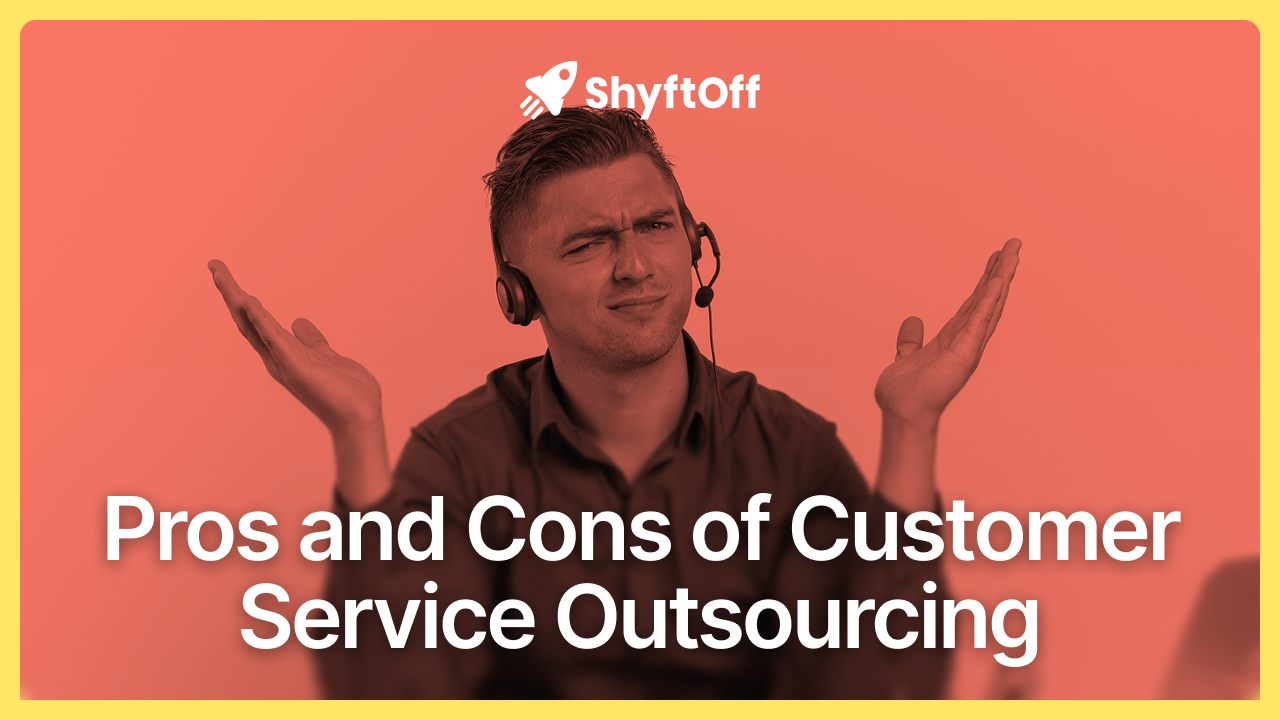
Customer service outsourcing has become one of the main ways of reducing operational costs, but it’s not just about saving money. There comes a point when each business has to decide whether to expand its in-house customer service team or turn to outsourced solutions.
In a nutshell, customer service outsourcing involves hiring a third-party service provider to handle your customer support. Providers like ShyftOff even offer flexible outsourced support, allocating more resources during periods of high volume and customer demand.
At first glance, outsourcing looks like an obvious choice for teams and companies scaling their business operations, but it is not risk-free. This guide breaks down the pros and cons of customer service outsourcing to help you decide if this is the right business decision for you.
What Is Customer Service Outsourcing?
Before we dive deeper into the pros and cons of outsourcing customer service, let’s take a moment to discuss what the term stands for. In simple terms, customer service outsourcing means using an external provider or support platform to handle some or all customer interactions, such as calls, live chat, email tickets, social media messages, or help desk requests. Here’s a summary of the key models by type:
- Call centers: Voice-based support teams that handle inbound or outbound customer calls.
- Chat/email support teams: Suitable for companies with a large number of customers.
- BPO companies: Business Process Outsourcing (BPO) companies hire large numbers of full-time support staff to provide outsourced support at scale.
- Global support providers: High-value outsourced customer support providers run international teams for 24/7 coverage.
Pros and Cons of Customer Service Outsourcing
Trying to decide whether customer service outsourcing is right for your company? The best way to find out is by checking and comparing the outsourcing customer service pros and cons:
Pros of Customer Service Outsourcing
The main benefit of customer service outsourcing is simply cost-efficiency. Still, there are also other standout perks worth considering, so here’s a full breakdown of the customer service outsourcing pros:
- Cost efficiency: Running an in-house support team incurs infrastructure expenses, not to mention hiring and training costs. Outsourced support models offer predictable monthly support costs, making it easier for companies to plan and scale their customer service budgets.
- Faster scaling of support teams: Training customer service representatives can take weeks or even months, which may not be fast enough during sudden spikes in customer demand. With an outsourced team, you can get a flexible plan and quickly scale up agents during product launches or seasonal spikes, as well as get global support with localized agents in different regions of operation.
- Access to experienced support agents: Strong outsourcing providers give businesses access to agents who already understand support workflows and customer experience best practices. They still need brand- and product-specific training, but the ramp-up is typically faster than coaching a new internal team from scratch. Providers like ShyftOff also emphasize matching businesses with agents who understand their requirements, customer needs, tone, and service expectations.
- 24/7 global customer support: There’s only so much that an internal customer support team can cover in a single workday. Outsourcing partners are a natural choice for companies that offer products and services across different regions and time zones. With the right provider, international teams and companies gain access to multilingual support and globally distributed agents.
- Improved operational focus: Outsourcing customer support services is worth the investment, as it relieves your internal team of these duties. With all the support-related queries handled by a third-party team, in-house employees can focus on higher-leverage priorities such as product development, marketing strategy, revenue growth, and customer experience planning.
Cons of Customer Service Outsourcing
Though the benefits of customer service outsourcing are many, the wrong provider choice can create serious problems. Here’s a snapshot of the biggest potential setbacks:
- Less control over the customer experience: When using an outsourced customer support team, it becomes increasingly difficult to maintain a consistent brand voice and tone in customer interactions. That’s why the choice of a vendor is crucial if you don’t want to deal with a misaligned response style and poor service quality.
- Potential quality inconsistencies: The quality of an outsourced customer support service also largely depends on the vendor. Some providers may rely on agents with only general category knowledge, which can create problems when customers need detailed product support or complex troubleshooting.
- Brand voice challenges: External teams may not automatically understand your brand’s tone and messaging. This is why clear documentation, strong onboarding, quality assurance, and regular feedback loops matter.
- Data security and privacy risks: Before you integrate an outsourced customer support service, review its security protocols, access controls, compliance processes, data-handling policies, and incident response procedures. When not done correctly, outsourcing might lead to breaches of sensitive customer data and misalignment with compliance requirements.
- Communication and management complexity: Finally, it might take some time before you can lean on an outsourced customer support team as much as you could on an in-house team. Along with workflow alignment challenges, time zone differences can also impede communication.
When Outsourcing Customer Service Makes Sense
Outsourcing customer support isn't always the best option. It all depends on the use case, so here are some scenarios where getting third-party help simply makes sense:
- Rapid company growth: Your customer base is expanding faster than anticipated, leaving you little to no time for hiring and training in-house support staff.
- Startups with limited resources: Running an internal support team also means paying salaries and employee taxes. That’s why outsourced support teams make a more cost-effective alternative.
- Companies expanding internationally: Outsourced support teams are more practical for businesses expanding their global reach, which might require multilingual and around-the-clock support across different time zones.
- Businesses with seasonal support demand: The ability to turn up the number of available agents during in-demand periods is invaluable for companies dealing with seasonal support spikes.
If you’re looking for greater flexibility, a hybrid model might be a game-changer. For instance, companies using a hybrid model might keep some support in-house while outsourcing overflow, after-hours coverage, seasonal demand, Tier 1 requests, or more complex interactions when the provider has the right training and escalation processes.
Final Thoughts
Outsourced customer support is a valuable tool for reducing internal customer support costs and improving scalability as your business grows. Choosing the wrong vendor, on the other hand, can lead to damaged customer relationships and a decline in support quality.
That’s why the best results come from a strategic partnership with a reliable customer support provider. ShyftOff provides a full-fledged Agentic Workforce Delivery Platform with trained agents from the US, LATAM, and the Philippines, delivering 35%-55% cost reductions compared to traditional BPOs.
Talk to our experts to learn more and find out if customer service outsourcing is the right call for your organization.
Frequently Asked Questions
Is outsourcing customer service a good idea?
Yes, outsourcing customer service can be a good idea for scaling startups and companies looking to expand their global reach and audience. It combines flexible models with 24/7 availability and multilingual support.
How much does customer support outsourcing cost?
Customer support outsourcing costs vary by channel, region, coverage hours, complexity, and pricing model. Basic offshore or shared support may cost relatively little, while dedicated, multilingual, technical, or 24/7 support can cost more. Many providers charge by the hour, minute, ticket, resolution, or dedicated monthly agent.
What are the biggest risks of outsourcing customer service?
When done right, call center outsourcing can provide a tight-knit environment with minimal risks. But go in unprepared, and you’ll be dealing with inconsistent brand voice, loss of product knowledge, security and compliance gaps, hidden operational costs, and KPI trade-offs.
Can outsourced agents provide high-quality support?
Yes, outsourced agents can provide high-quality support and respond to more than just Tier 1 tasks, but that requires inputs on your company's end to educate and train the outsourced team to perform at their best in your brand's name.
What industries outsource customer support the most?
While there's no exact rule, industries that outsource customer support the most include retail, insurance, finance, and others.
Is outsourcing better than building an in-house support team?
It depends on the company's support needs, budget, volume, and quality requirements. In-house teams may make sense when a business wants maximum direct control, but outsourcing can be better for flexible scaling, after-hours coverage, seasonal demand, and cost control.

Explore more of our Blogs













%2520(1)%2520(1).avif)




.avif)

.avif)




.avif)


.avif)


.avif)




%2520(2).avif)




.avif)
More of our Resources
Our Blogs
The solution has been deployed across more than 125 tourism organizations

Our Webinars
The solution has been deployed across more than 125 tourism organizations
Our Guides
The solution has been deployed across more than 125 tourism organizations
Our Stories
The solution has been deployed across more than 125 tourism organizations
Our Podcasts
The solution has been deployed across more than 125 tourism organizations
Our Events
The solution has been deployed across more than 125 tourism organizations