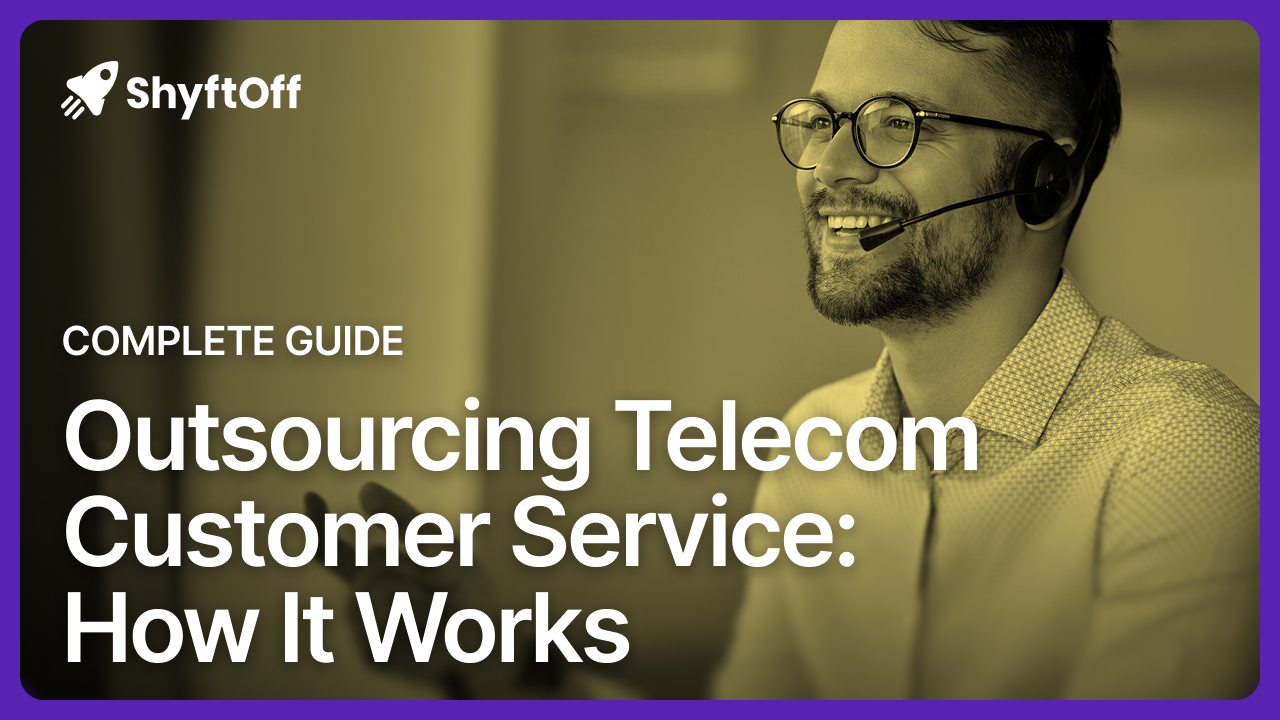
Key takeaways
- Telecom support is high-volume, technically complex, and requires fast, accurate responses.
- Outsourcing can extend in-house teams with scalable, 24/7 support capacity.
- Specialized outsourcing providers like ShyftOff handle customer relations, technical troubleshooting, and billing inquiries.
- Outages and product/service launches in telecom require flexible, on-demand support.
- ShyftOff offers a better alternative to traditional business process outsourcing (BPO) models with AI-powered matching, quality assurance (QA), and certified, flexible agents.
Telecom support is difficult to staff because a normal week can quickly turn into a surge due to an outage, billing issue, promotion, device launch, or service change. That means telecom companies often need a flexible way to add trained support capacity when demand rises, without carrying unnecessary overhead when volume drops.
Telecom customer service outsourcing can help with this. The right partner can extend an existing support operation with trained agents, omnichannel coverage, and the flexibility to scale in response to real-time customer demand.
ShyftOff approaches this as an Agentic Workforce Delivery Platform, helping contact centers match trained agents to real support needs without relying on the rigid structure of a traditional BPO.
What Is Telecom Customer Service Outsourcing?
Telecom is among the most demanding industries in terms of customer experience expectations. Customers expect instant problem resolution, and they often reach out during outages and service issues, regardless of the time.
Escalations are also rather quick, as tensions can be high when customers don't get their inquiries sorted out immediately. That is where telecom customer service outsourcing comes in. It’s the practice of partnering with a third-party support provider to handle some or all customer support functions.
Handling every telecom support function in-house has become difficult, as volume, channel coverage, training needs, and after-hours demand increase.
With telecom outsourcing, companies can shift selected support functions to specialized partners with existing support infrastructure to handle volume spikes and network-wide requests. Common outsourced telecom support functions include:
- Customer care: Includes billing disputes, plan changes, and account-related inquiries.
- Technical support: Spans network troubleshooting, connectivity issues, and outages.
- Sales and upsell support: Helps customers pick the right plans and runs promotional campaigns.
- Retention and churn prevention: Entices loyalty through solution-oriented support and addresses potential issues and cancellation requests.
How Telecom Customer Service Outsourcing Works
Telecom outsourcing works best when the scope, systems, staffing model, and performance expectations are clear from the start.
1. Needs Assessment & Scope Definition
Before picking a vendor, you need to know exactly what you’re looking for. Here’s a brief checklist to go by in this context:
- Volume forecasting: Define the scope of your average daily, weekly, and monthly estimates of support inquiries.
- Channel coverage: Determine whether you’d prefer to serve your customers by phone, live chat, email, or a combination of these.
- Support tiers: Figure out whether you’re mainly looking for basic Tier 1 support, like account and billing inquiries, or whether you want to provide more technically complex support.
2. Vendor Selection
Start by checking whether the vendor has experience in telecom customer service, including navigating billing systems, technical troubleshooting, and communicating during outages.
It’s also worth checking whether the platform integrates with your existing CRM, billing tools, and network monitoring systems to speed up the integration process. In telecom support, workforce model distinctions are particularly important, especially for around-the-clock support.
3. Onboarding & Training
One of the biggest transition points in telecom customer service outsourcing is onboarding. Agents need time to learn your products, services, tools, workflows, and escalation rules.
Providers like ShyftOff can shorten that ramp-up with trained agents and client-specific certifications.
Beyond product knowledge, proper onboarding and training require agents to become familiar with the billing system, network and device troubleshooting workflows, and tone and empathy guidelines.
4. Integration With Systems
Your outsourced support team must have access to the same tools your internal team uses. Before hiring, make sure to check integrations with:
- CRM platforms like Zendesk or Salesforce
- Billing platforms
- Customer account management tools
- Network status systems
With a platform-led outsourcing model, integration planning should focus on giving agents secure access to the CRM, billing tools, knowledge base, and network status systems they need to resolve issues quickly.
5. Go-Live & Scaling
With proper outsourced telecom support, the ramp-up should gradually reach peak volume. It’s best that you see and secure a pilot to measure customer support efficiency and how agents handle escalations in high-demand periods.
Platforms like ShyftOff are built around flexible capacity, so brands can scale support during demand spikes without paying for idle time, breaks, training, or other non-productive hours.
6. Continuous Optimization
Outsourcing telecom support doesn’t end at go-live. With ShyftOff, AI-powered QA can analyze 100% of agent interactions instead of a small manual sample. Some of the key performance trend metrics covered should include:
- CSAT (Customer Satisfaction Score): Refers to how satisfied the customers are with the service provided.
- FCR (First Contact Resolution): Indicates whether interactions are resolved on first contact or after callbacks.
- AHT (Average Handle Time): Measures how efficiently agents handle interactions without sacrificing service quality.
Why Telecom Companies Outsource Customer Support
Telecom companies usually outsource support for a few reasons:
- High ticket volume: Internal support teams can struggle to absorb sudden spikes in tickets related to billing disputes, account questions, device issues, and outages.
- 24/7 expectations: Telecom customers don’t experience connectivity issues or other problems at specified times, so they need a reliable, around-the-clock service.
- Seasonal spikes: New plan or service launches, promo campaigns, and outages are just some of the reasons behind unexpected, seasonal spikes that an outsourced team can flexibly handle.
- Cost pressure vs. quality expectations: With profit margins in telecom companies tight, paying agents only when you need them rather than full-time pay makes a significant difference.
- Need for multilingual/global coverage: Outsourcing platforms like ShyftOff feature agents in the US, Latin America, and the Philippines, providing wide coverage across different time zones.
Key Benefits of Telecom Customer Service Outsourcing
Outsourcing telecom customer support comes with many benefits, including:
- Scalable support capacity: Ability to add support capacity on demand.
- 24/7 omnichannel coverage: Complete coverage across telephone, live chat, email, and social media support.
- Reduced operational costs: ShyftOff partners have achieved total cost savings of 35% to 55% compared to traditional BPOs.
- Access to trained telecom agents: With the right choice of vendor, you get access to trained agents certified on your telecom workflows, support materials, escalation rules, and customer communication standards.
- Faster resolution times: Certified agents work around the clock to handle tickets and disputes quickly, while adhering to brand guidelines.
- Improved customer experience & retention: Outsourced agents can handle Tier 1–3 support.
Why Telecom Support Requires a Specialized Outsourcing Partner
Telecom support requires strong product training, workflow knowledge, and clear escalation guidance. Generic support models often struggle because of:
- Technical complexity: Telecom support revolves around networks, billing systems, account plans, hardware configurations, and technical workflows.
- High customer frustration: Outages and billing issues require calm, empathetic support.
- Real-time issue resolution expectations: Customers expect fast answers during high-demand periods.
- Multi-channel communication: Telecom support is a chat-heavy industry, so agents are expected to respond quickly and clearly. Outsourced agents are trained for this.
- Need for rapid scaling during outages: Flexible headcount helps absorb sudden volume spikes.
What to Look for in a Telecom Customer Service Outsourcing Partner
The right telecom outsourcing partner should support your budget, service levels, customer experience, and long-term flexibility. Look for:
Ability to Scale Instantly
Unlike traditional BPOs built around fixed shifts, platforms like ShyftOff can add trained agents in smaller increments during outages, launches, or other high-volume periods.
Telecom-Specific Expertise
Look for agents trained in billing systems, device troubleshooting, network outage support, and sensitive customer conversations. Ideally, the partner should support Tier 1 through Tier 3 interaction.
Omnichannel Support Capabilities
Different customers might use different support channels. The safest bet is to go with an omnichannel support vendor whose agents are trained in voice, chat, and email. In 2026, social support may also matter, depending on the customer base.
Workforce Flexibility
Fixed full-time workforce models can work for predictable volume, but telecom demand often rises and falls throughout the day.
Platforms like ShyftOff take a different approach, with flexible agents working shorter shifts and switching in and out. Agents are matched to your brand and requirements, and you only pay for the time they’re actively working.
System Integration Capabilities
If the agents are not familiar with your tools and systems, they can’t effectively provide support services. That’s why it’s important to check whether the vendor’s services seamlessly integrate with your CRM, billing infrastructure, and other systems.
Performance Visibility & QA
ShyftOff’s AI-powered QA tools are the perfect example of the level of reporting transparency you’d need. It’s important to have real-time access to agent performance, CSAT scores, and other customer satisfaction metrics.
Final Thoughts
When done right, outsourced telecom customer service becomes a competitive edge. It’s not just about cutting costs and providing basic, Tier 1 service to customers. It’s about boosting customer service quality flexibly, at scale, without overpaying for training, onboarding, lunch breaks, or benefits.
Choosing the right model matters most because telecom support depends on speed, availability, technical knowledge, and the ability to scale when volume changes.
Contact ShyftOff to explore a telecom support pilot and see how flexible outsourcing could fit around your current team, service levels, and customer demand patterns.
Frequently Asked Questions
What is telecom customer service outsourcing?
Telecom customer service outsourcing involves partnering with a third-party vendor to handle your billing inquiries, technical troubleshooting, account management, and retention.
How does telecom outsourcing work?
Telecom customer service outsourcing starts with the internal assessment of support requirements. Then, you'd need to select a vendor, provide materials and brand-specific resources for the onboarding phase, and integrate the platform into your existing systems.
Can outsourced teams handle technical support?
Yes, outsourced vendors like ShyftOff feature specialized agents who can handle Tier 1 through Tier 3 requests.
How quickly can support teams scale?
Support teams can scale quickly with flexible models like those offered by ShyftOff, as agents can be called on duty within minutes and work flexible shifts during moments of increased demand.
Is telecom outsourcing cost-effective?
Yes, telecom outsourcing can be quite cost-effective, assuming that you pick the right vendor. ShyftOff saved its partners 35% to 55% compared to estimated BPO costs.
What channels can be supported?
An outsourced team should be trained to handle omnichannel support, including phone, live chat, email, and social media.

Explore more of our Blogs









%2520(1)%2520(1).avif)


.avif)
.avif)


.avif)


.avif)


.avif)



%2520(2).avif)


.avif)
More of our Resources
Our Blogs
The solution has been deployed across more than 125 tourism organizations

Our Webinars
The solution has been deployed across more than 125 tourism organizations
Our Guides
The solution has been deployed across more than 125 tourism organizations
Our Stories
The solution has been deployed across more than 125 tourism organizations
Our Podcasts
The solution has been deployed across more than 125 tourism organizations
Our Events
The solution has been deployed across more than 125 tourism organizations